Abstract. DRD-08 formalizes the DAGRA (Distributed Air-Ground Resilience
Architecture) three-layer model (A/G/R) developed through adversarial modelling in May 2026.
The central argument is that energy and data infrastructure haavoittuvuus constitutes a larger
structural risk than platform inventory. Against hypersonic threats (Kinzhal, Tsirkon, Avangard),
F-35 assets represent concentrated vulnerability — eggs in few baskets — while R-layer
investment is the only instrument retaining meaningful defensive value across the full threat
spectrum including nuclear HGV. Sensitivity analysis demonstrates R-layer marginal returns
5–15× those of A-layer investment when R < 25% of budget. The Nash-equilibrium allocation
is 40A/35G/25R; risk-adjusted for US commitment uncertainty: 35A/40G/25R.
§ 01
DAGRA: Three-Layer Architecture
DAGRA structures defence investment into three functionally distinct layers, each with
different fragility profiles, adversary targeting logic, and diminishing-returns curves:
Layer
Content
Fragility λ
Diminishing returns
A — Air coherence
F-35 fleet, NATO ISR integration, C2 core, sensor fusion, EW protection
5.0 (high)
Rapid above 40%
G — Ground denial
GBAD (Patriot/NASAMS/IRIS-T), mobile radars, MANPADS, long-range fires, C-UAS
1.0 (low)
Moderate
R — Resilience
Energy islanding, data redundancy, logistics continuity, C2 fallbacks, cyber
2.5–4.0 (E/D split)
Very low below 30%
The deterrence function is non-additive:
D = (A · G) + (R · (A + G)) − failure_thresholds
This multiplicative structure means A without R is brittle, R without A lacks strategic
reach, and G without A cannot prioritise engagements. The three layers are complements,
not substitutes — except in catastrophic scenarios where A and G are eliminated and only
R determines post-strike survivability.
§ 01b
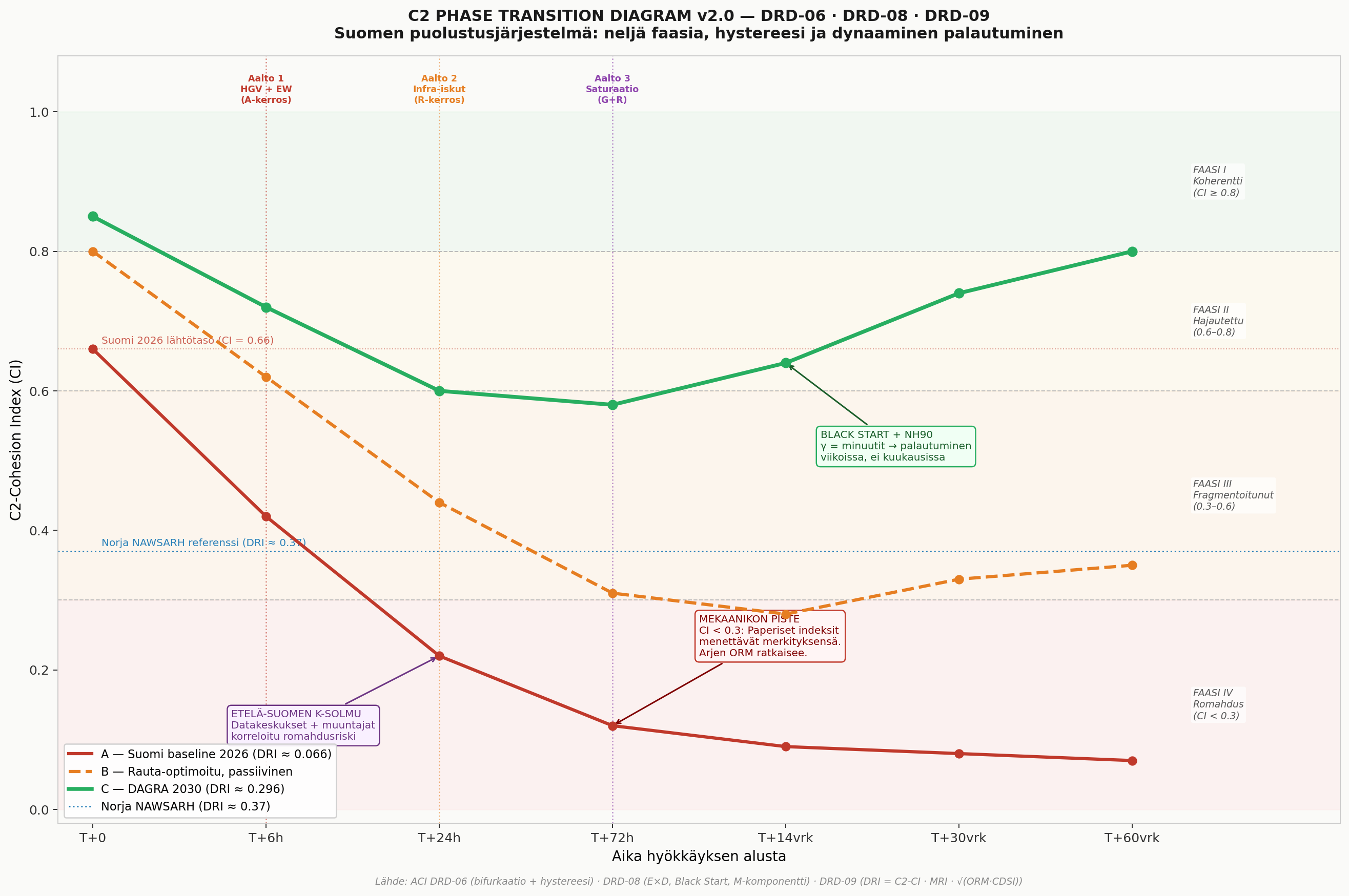
C2 Phase Transition Diagram v2.0
The diagram below synthesises DRD-06 (bifurcation and hysteresis), DRD-08 (E×D,
Black Start, M-component) and DRD-09 (DRI composite) into a single visualisation.
Three simulated trajectories show the difference between the 2026 baseline,
hardware-only hardening, and the DAGRA 2030 target architecture.
Käyrä A (punainen): Suomi 2026 baseline — romahtaa Faasiin IV T+24h mennessä ilman palautumista.
Käyrä B (oranssi katkoviiva): Rauta-optimoitu — hidastaa putoamista mutta jää Faasin III alarajalle.
Käyrä C (vihreä): DAGRA 2030 — joustaa Faasiin II, Black Start + NH90 palauttavat koherenssin viikoissa.
§ 02
The Infrastructure Vulnerability Argument
The central claim of DRD-08 is not that F-35 is a poor investment in isolation, but that
under the 2026 threat environment it represents concentrated vulnerability — eggs in few
baskets — while energy and data infrastructure represent a larger structural risk that
receives systematically less investment.
The concentration problem
Finland's F-35 fleet of 64 aircraft, even when dispersed under ACE doctrine across highway
strips and dispersal bases, remains a finite and enumerable set of high-value targets. Each
aircraft represents approximately 150–200 million euros in acquisition cost plus lifecycle
overhead. A coordinated first strike with 6–8 Kinzhal missiles against three primary airbases
— each capable of Mach 10 penetration at ranges exceeding 2 000 km — would destroy or
disable a significant fraction of the fleet before dispersal is complete.
Energy and data infrastructure presents the inverse problem: it is geographically distributed
but functionally centralised. Finland's grid has fewer than 20 critical transformer nodes whose
simultaneous destruction would black out the country. Fibre backbone routes follow a small
number of physical corridors. GPS dependency permeates military and civil systems alike.
Structural finding: F-35 concentration risk is mitigated by dispersal doctrine
(ACE) but cannot be eliminated. Infrastructure concentration risk is mitigated only by
islanding and redundancy investment — which currently receives approximately 10% of the
defence budget versus 60% for A-layer.
The E×D decomposition
R-layer effectiveness is not a single scalar but the product of two independent dimensions:
E (Energy Resilience Index): probability that critical nodes retain
power post-strike. λE = 3.0. A small number of HGV strikes against transformer
stations can collapse grid over large areas.
D (Data Resilience Index): probability that C2 communications survive
EW and physical attack. λD = 4.0. EW at Kinzhal/Tsirkon ranges degrades GPS,
radio and fibre simultaneously.
R-layer effective contribution: R_eff = √(E · D)
If either E or D reaches zero, R-layer contribution collapses regardless of investment in
the other. A defence posture with excellent energy islanding but no data redundancy — or
vice versa — achieves near-zero R-layer effectiveness under combined EW + kinetic attack.
E
D
R_eff = √(E·D)
C2 phase
0.8
0.8
0.80
Phase I–II (coherent)
0.6
0.6
0.60
Phase II (boundary)
0.5
0.5
0.50
Phase II–III transition
0.4
0.6
0.49
Phase III (fragmented)
0.3
0.3
0.30
Phase III–IV boundary
0.8
0.1
0.28
Phase IV despite strong energy
The last row is critical: high energy resilience with low data resilience produces Phase IV
collapse. The weakest of E or D governs the system outcome. This has a direct investment
implication — the marginal euro should go to whichever of E or D is currently lower, not to
the one already higher.
§ 02b
Black Start Capability and Data Centre Concentration Risk
Black Start: the dynamic E-component
Energy resilience (E) has two sub-dimensions. Static E measures whether critical
nodes have power during an attack. Dynamic E measures how quickly power is restored
after a pulse — the recovery rate γ in DRD-06 Extension C. Black Start capability — automatic
inverter-based grid restoration in minutes rather than hours — governs γ directly.
Under pulsed AT(t) with 6-hour inter-pulse intervals, a γ implying 14-hour recovery time
means the system cannot return to Phase II coherence before the next pulse. Black Start is
therefore not supplementary hardening but a prerequisite for pulsed resilience. Without it,
microgrid investment raises static E while leaving dynamic E near zero. Estimated additional
cost: ~150–200M EUR above the core energy islanding programme.
Data centre concentration: a new K-term
Rapid data centre growth in southern Finland introduces a new node concentration risk
(the K-term in DRD-06 Extension B, C_crit = f(D,R_d,A_q,E_p) − g(K,N_d)). Data centres
concentrate grid load and fibre traffic in the area with Finland's highest existing
transformer density, creating three compounding effects:
Shared physical infrastructure: Military C2 nodes and commercial
data centres draw from the same transformer stations and fibre corridors. A strike
targeting data centre infrastructure simultaneously degrades military C2.
Increased N_d (network dependency): Smart-grid integration of
data centre power management creates correlated failure modes absent in simpler
architectures.
Huoltovarmuus degradation: Supply security experts have warned
the data centre boom draws grid capacity toward commercial optimisation at the
expense of resilience-critical uses.
Structural implication: Data centre concentration in southern Finland
raises K and N_d simultaneously, lowering C_crit without any change in adversary
capability. This is a self-inflicted reduction in the bifurcation threshold.
§ 02c
M-Component: Mobility Resilience
DRD-08's R-layer is extended by a third component identified in CN-014
(Distributed Helicopter Resilience, May 2026). The E×D multiplicative structure
captures static infrastructure continuity. The M-component captures dynamic,
mobile capability that maintains C2, logistics and human rescue even when fixed
infrastructure is damaged or destroyed.
The revised R-layer effective contribution:
R_eff = √(E · D) · f(M)
where f(M) is a mobility resilience factor scaling between 0 and 1.
At M = 0 (no mobile capability), R_eff collapses regardless of E and D values —
static infrastructure without evacuation and logistics continuity cannot sustain
C2 under sustained operational stress. At M = 1 (fully integrated dual-use
rotary wing assets), R_eff reaches the full √(E·D) value.
Three M-layer functions
Mobile C2 node: NH90 as a flying command-and-control relay,
maintaining situational picture and communications when ground nodes are destroyed
or isolated. This directly sustains the D-component under EW and kinetic attack.
Logistics continuity: Forward fuel, ammunition, spare parts and
medical supply delivery when road and rail infrastructure is degraded. This extends
the operational timeline before static infrastructure failure forces Phase IV transition.
Human rescue and evacuation: Civilian evacuation, casualty
extraction, HEMS delivery to trauma facilities. Without this, societal endurance
(the R-layer floor identified in TN-010) degrades rapidly under sustained pressure.
Current Finnish state: M ≈ 0.2
Finland operates three separate helicopter organisations with no common operational
framework: Defence Forces (20 NH90 + 7 MD500, ~30 executive assistance tasks per year),
Border Guard (Super Puma, AB206), and FinnHEMS (EC135, H145, 8 bases, civilian HEMS).
The ~30 annual executive assistance tasks represent a small fraction of the NH90 fleet's
theoretical dual-use capacity. Eastern and northern Finland are underserved by the civilian
HEMS network — Rovaniemi is the northernmost base.
Norway's NAWSARH/SAR Queen model (16–18 AW101, six bases, Ministry of Justice ownership,
Air Force operation, Joint Rescue Coordination Centre command) achieves M ≈ 0.8 through
institutional integration rather than additional procurement. The same aircraft serves
both peacetime SAR and wartime military roles. ~1,000 SAR tasks per year versus Finland's
~30 executive assistance tasks — same country size, same population.
Three investment steps to raise M
NH90 dual-role systematisation (10–20M EUR one-time):
define peacetime SAR/HEMS role and wartime military role; establish cross-ministry
steering group (Justice, Defence, Health); equip for HEMS/SAR configuration.
HEMS coverage expansion (5–10M EUR/year): position 2–3 NH90
on standby in eastern Finland and Lapland; train crews for paramedic tasks with
FinnHEMS; fund from central government, not welfare districts.
Reserve specialist model (0–5M EUR/year): target reservist
age-limit extension at helicopter operation specialists (aviation maintenance,
paramedics, logistics); corporate tax incentive for reserve training funding.
Total budget impact: 10–20M EUR one-time + 5–15M EUR/year. This is <2% of the
energy and data infrastructure investment (§03) and <0.1% of F-35 lifecycle cost.
The cost-to-strategic-benefit ratio is the highest in the R-layer investment portfolio.
Using the loss function L = Σ w_k · (1 − exp(−λ_k · α_k)) with weights
wA=0.5, wR=0.3, wG=0.2, sensitivity analysis compares
the effect of a marginal 100M EUR added to A-layer versus R-layer:
R baseline
+100M to A (ΔL)
+100M to R (ΔL)
R/A benefit ratio
R = 10% (E=D=0.2)
−0.01
−0.15
15×
R = 20% (E=D=0.4)
−0.02
−0.10
5×
R = 30% (E=D=0.55)
−0.03
−0.06
2×
R = 40% (E=D=0.7)
−0.04
−0.03
0.75× (A now better)
R-layer marginal returns exceed A-layer returns by 5–15× when R < 25% of budget.
Finland's current R allocation (~10%) places it in the 15× marginal return zone —
the highest possible infrastructure investment leverage point.
Critical operational thresholds
Phase II C2 coherence (CI ≥ 0.6) requires E ≥ 0.5 and D ≥ 0.5 simultaneously.
Estimated current Finnish state: E ≈ 0.3–0.4, D ≈ 0.4–0.5. This places the system
in Phase III under moderate operational stress — without any kinetic engagement.
Automatic inverter-based grid restoration for C2 nodes (dynamic E recovery rate γ)
~150–200M EUR
γ: hours → minutes
Pulsed resilience enabled
Total
All categories required — E×D multiplicative + Black Start dynamic recovery
~1.35–1.4B EUR
E≈0.65, D≈0.65, γ fast
Phase III → Phase II + pulse resilience
~15–20% of annual defence budget as one-time
investment. Transition from estimated current state (E≈0.35, D≈0.40) to Phase II threshold
(E≥0.50, D≥0.50). All three categories are required — the E×D multiplicative structure
means partial investment in only one dimension produces near-zero R-layer gain.
§ 04
Hypersonic Threat Layer and DAGRA Implications
System
Speed
Warhead
Intercept
DAGRA relevance
Kh-47M2 Kinzhal MiG-31K / Tu-22M3 · range 2 000+ km · proven in Ukraine
Mach 10
480–500 kg conventional
Patriot: limited
G-layer design case
3M22 Tsirkon Ship / submarine / ground · range ≈1 000 km · limited Ukraine deployment
Mach 8–9
Conventional
Extremely difficult
G-layer marginal
Avangard HGV ICBM-carried · range 6 000+ km · altitude 80–90 km · production constrained
Mach 20+
Nuclear
Not interceptable
R-layer only + Article 5
Against Avangard, A-layer and G-layer are operationally irrelevant as defensive instruments.
The only structurally coherent responses are NATO collective deterrence (Article 5) and
R-layer post-strike survivability. This is the strongest possible argument for R-layer
investment: it is the sole defensive layer with relevance across the full threat spectrum
from drone swarms through conventional hypersonics to nuclear HGV.
Note on production constraints: Russia has reported Avangard production limitations.
Small inventory does not reduce strategic threat — a handful of strikes against Finnish
C2 and energy nodes would achieve rapid systemic collapse. Limited inventory reinforces
rather than diminishes the R-hardening case.
§ 05
Budget Simulation: Current vs Optimal Allocation
Scenario
A
G
R
L (Venäjä strikes A)
Risk profile
Current (64 F-35)
60%
20%
10%
0.82
High rapid-collapse risk
Nash optimum 6.5B
40%
35%
25%
0.52
Balanced, all scenarios
Risk-adjusted (US uncertainty)
35%
40%
25%
0.55
Robust to low US commitment
Nash optimum 8.5B
40%
35%
25%
0.48
High deterrence, R fully funded
Path dependency note: the F-35 lifecycle commitment (~25–30B EUR over 30 years, with
~730M EUR currency losses already accrued) constrains rapid reallocation. The realistic
transition path is 60/20/10 → 45/35/20 (near-term) → 40/35/25 (medium-term as F-35
early costs are absorbed). The critical constraint is that R must reach 20% before G
reaches 35% — the multiplicative E×D structure means an under-resourced R negates G
investment effectiveness in extended conflict.
§ 06
Investment Priority Sequence
Energy islanding of C2 critical nodes — highest marginal return
(15× vs A-layer), achieves E ≥ 0.5 threshold. ~500M EUR. Timeline: 3–5 years.
Data redundancy infrastructure — satellite terminals, HF radio,
fibre rerouting. Achieves D ≥ 0.5. ~300M EUR. Timeline: 2–4 years.
GBAD expansion — Kinzhal is the primary design case.
NASAMS/Patriot mobile units, C-UAS. ~800M EUR/yr additional. Ongoing.
Further F-35 acquisition — lowest marginal return once R ≥ 25%
and G ≥ 35%. Lifecycle commitments already made; future acquisition decisions
should apply diminishing-returns test explicitly.
Core finding: Against the 2026 threat environment (Kinzhal + Tsirkon +
Avangard + drone swarms), energy and data infrastructure hardening produces higher
deterrence return per euro than additional airframe acquisition at current allocation ratios.
This is not an argument against F-35 — it is an argument for correcting systematic
R-layer underinvestment before the E×D multiplicative floor collapses C2 coherence
regardless of platform inventory.
§ 06b
ACI Implementation Pathways for R-Layer Investment
The R-layer investment priorities in §06 have concrete implementation pathways in the
ACI research programme — operationalised frameworks addressing the same structural gap
from the civilian energy system side.
DRD-08 requirement
ACI pathway
Ref
Energy islanding (static E ≥ 0.5)
SGFA CHP retrofit — distributed CHP at municipal nodes,
islanding-capable under pre-allocation PPA conditions
SGFA and MESA were developed as civilian energy resilience instruments. DRD-08's R-layer
requirements and the SGFA/MESA implementation pathways are converging solutions to the same
structural problem: Finland's critical infrastructure is optimised for efficiency under
stable conditions and fragile under simultaneous grid stress and adversarial pressure.
The investment case is identical from either direction.